What sparked this post. On 2 October 2026 (UTC) @chisedesuyo_ai published an X Article titled roughly “How to choose between Grok Bot and dots — a thorough comparison.” The next day @MakeAI_CEO quote-tweeted it with a short video, saying the differences finally clicked. We already have a model-level orientation at dots vs Grok Bot; this post is the decision playbook side — contracts, handoff style, and a first trial prompt. Checked against public pages as of the article’s 2 Oct 2026 note; not a head-to-head timed test.
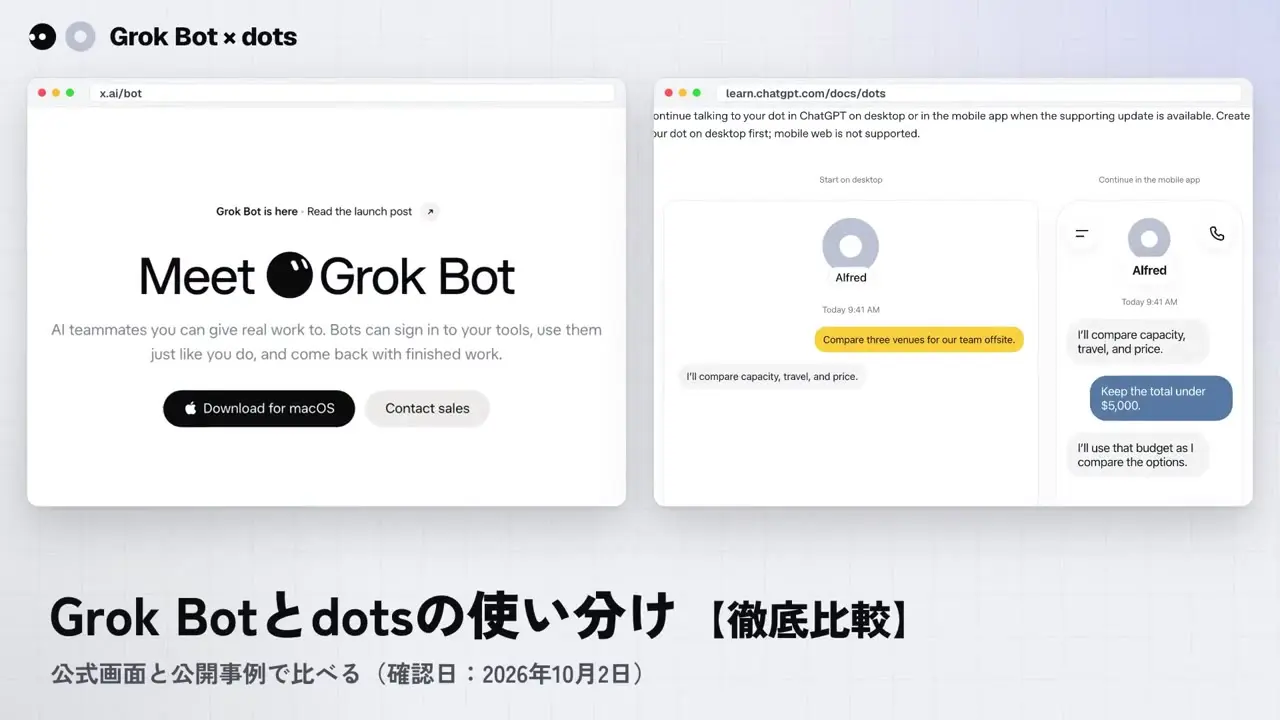
Community-hosted · attributed
Community reaction video (attributed @MakeAI_CEO): short clip quoting the Japanese how-to-choose article on Grok Bot vs dots. Full post: https://x.com/MakeAI_CEO/status/2106284486581465498
Start from the plan you already have. The article’s practical rule: if you are on eligible ChatGPT Pro (or another plan that already shows a dot), try dots first; if you already have an eligible Cursor / SuperGrok path into Grok Bot, try Grok Bot first. Adding a second vendor “just to compare” is optional after one small real task. Official dots getting-started and plan notes: Help, our eligibility and pricing. Grok Bot entry and billing: vendor pages such as x.ai/bot and Cursor’s Grok Bot plan help — quote their numbers from the live page, not from memory.
One primary desk vs named handoffs. dots are often used as a primary agent you keep briefing — several jobs share context under one identity (with parallel work behind the scenes per OpenAI’s tasks & memory docs). Grok Bot marketing and guides lean into named bots with roles that pass artifacts to the next owner (research → outline → fact-check). Neither slogan is absolute: you can run one Grok Bot alone, and dots can run multiple agents in parallel. Prefer “how work is handed off” over “who has more agents.” Orientation: what is dots.
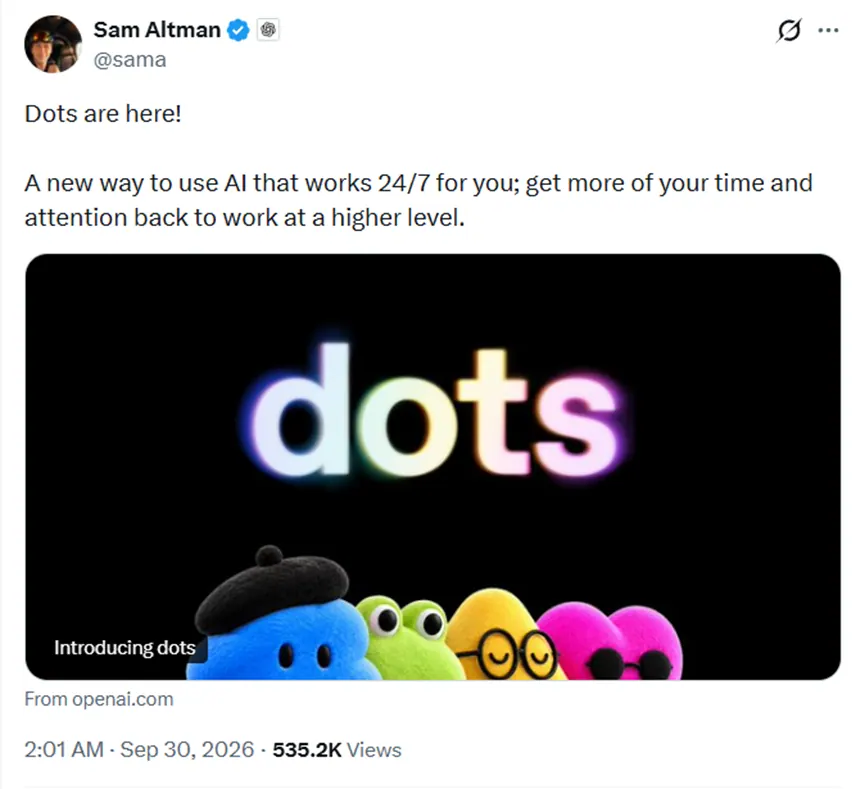
“Always on” is not “unlimited.” Both products talk about cloud computers and continuing work. That is not the same as unlimited deep work. Dots have usage for deeper jobs; work handed to Codex / ChatGPT Work still counts toward those products’ limits. Grok Bot materials describe weekly quotas and optional overage — overage caps may not freeze an already-running job mid-flight. Also: a laptop connection for local files is a different story than cloud-only work — “keeps working with the lid closed” only applies to jobs that do not need that machine online. Cite each vendor; do not invent quotas here.
What fits dots first. Good first tries: deal prep from shared notes, meeting prep from last minutes + agenda, content planning from your own published posts, proposal diffs from before/after requirements — anything where one desk should keep the goal and you can verify the draft. OpenAI’s public anecdotes (for example invoice catch-up after human approval) are illustrations, not guarantees. Ask for structured outputs (“confirmed / unanswered / next checks”) rather than “make this deal succeed.”
What fits Grok Bot first. Good first tries: a clear pipeline with named deliverables between roles (source-backed fact list → outline → claim audit), or a narrow recurring chore such as changelog hygiene from known diffs. Public case studies (multi-bot app ops, procurement research bots, blog update routines) show division of labour, not a controlled A/B score. X search / timeline connectors are useful for publishers — still separate from “free unlimited API.” Keep a verification owner who opens original URLs; two bots repeating a wrong claim is not two sources.
Shared computers and privacy boundaries. Grok Bot docs note bots on the same account can share a cloud computer (files, browser logins, CLI creds) — naming “Client A bot” and “Client B bot” is not isolation. Dots privacy FAQs note that disconnecting an app does not erase what a dot already absorbed, and there may be no fine-grained “edit this memory” control — deleting the dot removes that context, not every file it wrote elsewhere. Trial with public or fictional samples when you can; limit live client data by matter and date. Sources pointed by the article: Grok Bot computer & apps, dots privacy FAQ.
A first brief you can paste (adapt names). Ask for a one-shot competitive scan: last 7 days of official announcements for three named competitors; list change, date, source URL; separate facts from speculation; note impact on your business and what a human must still check; stop after the report — no send, post, purchase, or file overwrite; ask before any new paid service. When the result returns, time how long you spent verifying URLs and spotting mixed speculation — that verification time is part of the trial. Pair with our safety habits (draft ≠ send).
Related. Model comparison: dots vs Grok Bot, dots vs Muse. Workflow and approvals: workflow deep-dive. Official: Introducing dots, features. Original JP article (source of this paraphrase): X Article via @chisedesuyo_ai. Reaction clip: @MakeAI_CEO.